
80/20 Rule in
Home Organization
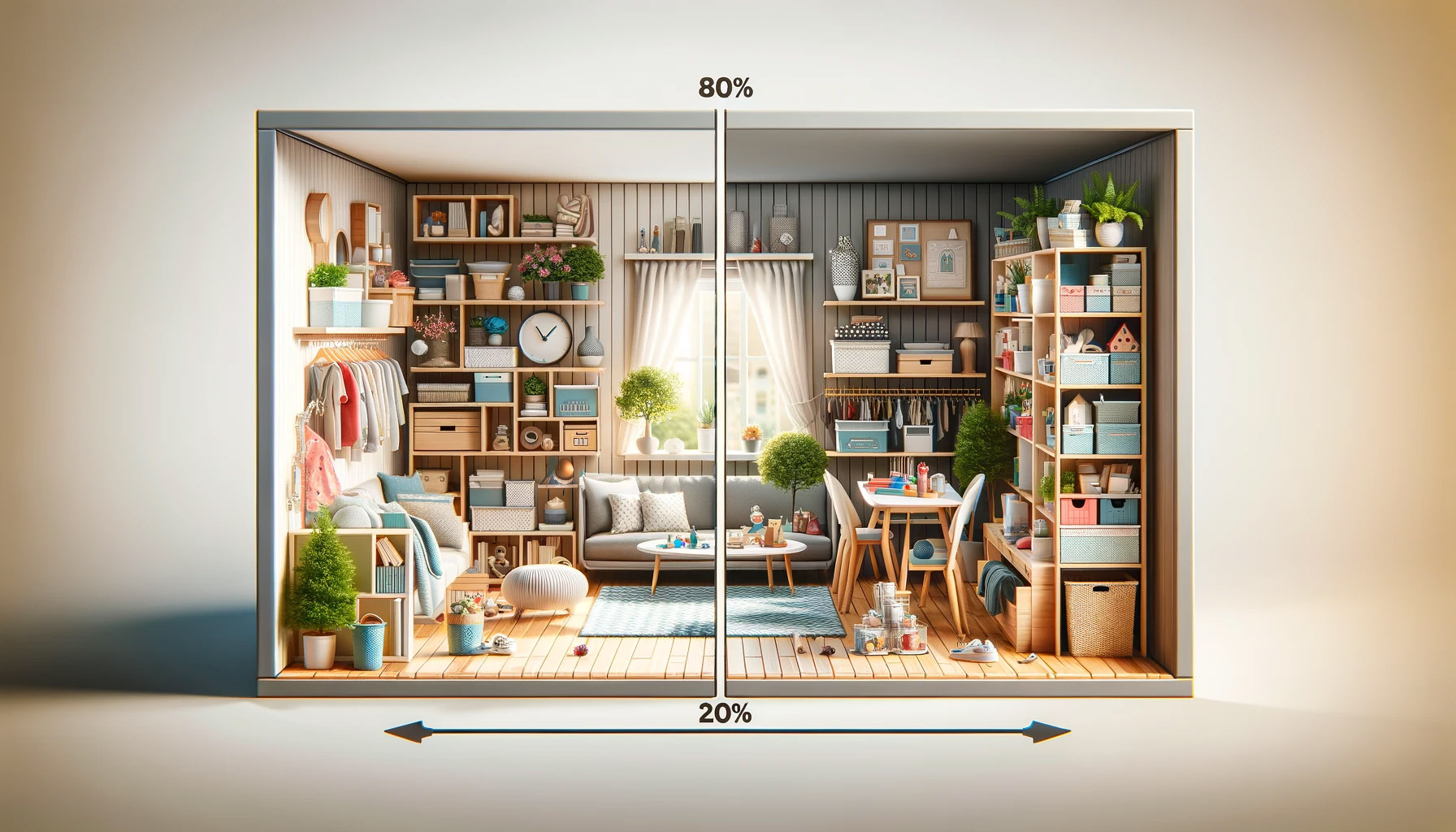
Search “home organization tips” and you will find longer projects: more bins, more labels, more weekend purges filmed for social media. Wrong target. In real households, most daily calm - and most daily friction - already concentrates in a few places: the entry drop zone, the kitchen clear plane, a short list of high-use items that need a permanent home, and one reset habit that actually runs. The rest of the house often gets equal guilt and equal shopping without changing Monday morning.
That is not a slogan about minimalism as a personality. How people experience their homes tracks stress physiology in research. Darby Saxbe and Rena Repetti analyzed home-tour language from dual-income spouses and found that when wives’ descriptions leaned more toward clutter and an unfinished home (“stressful home” scores), they showed flatter diurnal cortisol slopes over the following weekdays - a pattern linked with worse health profiles - and more depressed mood across the day; more “restorative” home language tracked the opposite direction (Personality and Social Psychology Bulletin, 2010). The study does not prove that a messy counter causes disease. It is a warning that living inside unmanaged clutter is not a neutral aesthetic choice for everyone in the house.
Put your time on the few zones and habits that keep showing up when the house feels usable. Ignore the urge to “fix” every closet before the entry works. This is for busy households - not a museum-curation course, not a judgment of people with less space or less money, and not medical advice. Broader habit lens: 80/20 in time management.
A busy tidy day can still be a low-concentration day
A full Saturday of organizing can still leave the week chaotic. Relabeling a guest closet, buying matching baskets, and sorting sentimental boxes create the feeling of progress while keys, bags, dishes, and outbound kid gear keep exploding in the same two square meters. Organization hides the skew the same way calendars do: hours of motion without touching the friction that decides most evenings.
Time cost shows up even in commercial surveys. The Choosi Clutter 2.0 report (Australian adults, online survey, n≈1,209) reported an average of 3.6 hours a week - about 187 hours a year - spent cleaning, organising, or decluttering, and named insufficient storage (37%) and accumulation outpacing culling (31%) among top clutter reasons (Choosi Clutter 2.0 whitepaper). Treat those figures as a time-cost shape from one country’s survey, not a law of physics. The transferable point: households already spend real hours on clutter work - so spending those hours on the wrong rooms is expensive.
A seven-day home friction audit you can actually run
Before buying another organizer set, run a short measurement. This worksheet is the core of the piece.
Protocol (pattern, not a clinical instrument)
- For seven days, at day’s end, write 1–3 friction moments: where you lost time, raised your voice, or felt the house “win” (buried counter, missing keys, laundry choke, entry pile, homework table takeover).
- Estimate minutes that day on majority fillers: reorganizing a rarely used closet, scrolling storage ideas, sorting boxes that have not been opened in a year, “just tidying everywhere a little.”
- After a week, list recurring zones and habit types. Score each with the signals (0–2 points each). Circle the top two scores.
- Those top two are your candidate vital few. Everything that filled hours but never appeared as a friction win when fixed - or never appeared as friction at all - is your ignored majority.
| Signal (0–2) | Question |
|---|---|
| Daily contact | Do you touch this zone every day on the way in or out? |
| Time tax | Does mess here cost minutes of searching or cleaning most days? |
| Mood load | Does this surface change how the whole room feels when clear vs buried? |
| Shared friction | Do multiple people dump or fight here? |
| Reset leverage | Would a short daily reset here unblock several other chores? |
| Intake choke | Is this where new stuff and paper first enter the house? |
Illustrative sample: a household’s seven-day log showed friction clustering at the entry drop zone and the kitchen island, plus missing chargers and school bags. Hours filled with sorting the guest-room closet and buying cube organizers almost never reduced the next day’s friction tags. Top scores: entry reset + kitchen clear plane. That pair became the week’s orbit - not a whole-house color-coded system.
The ignored majority: what expands to fill every weekend
- Equal tidying of every room “so it is fair”
- Buying bins before stopping the inflow of duplicates and freebies
- Whole-house purge weekends that relapse by Wednesday
- Organizing rarely used storage while the entry stays a landfill
- Keeping “just in case” duplicates that have never been the case
- Matching aesthetic systems that require more maintenance than the mess
Trimming this majority is not coldness toward memories. It is refusing to let low-friction rooms consume the hours when high-friction zones actually decide the week. Clothes that never leave the closet have their own concentration story in 80/20 in wardrobe management. Money spent on unused organizers rhymes with 80/20 in personal finance.
8020 move: This week, name three filler tasks that never showed up as friction reductions. Cancel one shopping trip for organizers, shorten one purge to a single zone, and put a donation bag by the entry so outflow has a path.
Protect the few zones that already carry the house
Once you know which two zones or habits concentrate friction, the next move is small: give them a permanent setup and a daily reset, and treat that window as unavailable for majority projects. You do not need a magazine kitchen. You need the vital few to stop losing to whatever arrives first.
- Entry / exit drop zone - one landing for keys, bag, mail decision (trash / action / file), and outbound gear. If it does not have a home within two steps of the door, it becomes a pile.
- Kitchen clear plane - keep one counter strip empty enough to cook and put down groceries. Dishes and mail do not get to colonize that strip.
- High-use item homes - keys, wallet, chargers, headphones, kids’ shoes/bags. One place each beats five “temporary” places.
- One daily reset - ten honest minutes on the top two zones before screens or sleep. Not a deep clean. A return to baseline.
Three days of protecting those is enough to test whether concentration - not more storage furniture - was missing. Saxbe and Repetti’s finding is useful here as a boundary: if how the home feels tracks stress markers for some people, obsessing over a rarely used closet while the shared drop zones stay chaotic is optimizing the wrong variable.
Illustrative: a parent who felt “always behind” moved a hook-and-tray setup to the real door they use, cleared one kitchen strip, and ran a ten-minute reset after dinner. Friction tags shifted toward “could find stuff” without a whole-house KonMari month.
When everything feels urgent, match the skew
Guests tomorrow, a sick day, and a delivery pile are loud. Concentrated-value organizing is quieter. When the house blows up, ask which move still matches your audited vital few:
- Reset first: what returns the entry and kitchen to usable in ten minutes?
- Hard-to-reverse: wet laundry, food left out, a blocked exit path?
- Prevention: stop one intake stream (mail, school papers, packages) before you buy another bin?
Pick one. Ideally one that also matches your scored top two. Do not redesign the garage during a kitchen spiral.
Other methods are secondary until concentration is known
Category purges, rainbow closets, and custom millwork help only after you know where friction concentrates. Without that map, you can organize the wrong rooms with impressive discipline.
| Method | Optimizes | Ask first |
|---|---|---|
| Whole-house weekend purge | Volume removed once | Which zones create daily friction tags? |
| Matching bin systems | Aesthetic / shopping | Has intake slowed, or will bins fill with the same flow? |
| Equal chore charts for every room | Fairness theater | Which two zones deserve unequal daily minutes? |
| Deep-clean rarely used spaces | Guilt relief | Did this ever appear as a friction moment this week? |
| More storage furniture | Capacity | Is the problem capacity - or no home for high-use items? |
Same hours, different concentration
Before: weekend purge energy, weekday relapse, bins for every category, equal tidy passes through unused rooms, and a standing fight at the door every school morning.
After a seven-day audit shows entry + kitchen as the vital few - and guest-closet sorting as majority - the same roughly busy week can re-cluster: hooks and a mail rule at the real door; one clear kitchen strip; ten-minute reset; donation bag always open. Related when “organized” is really about knowing what you own for safety: 80/20 in home security.
8020 move: End each week with: “Which two zones created the most calm when clear, and what stole minutes from them?” Adjust next week’s reset before you open the shopping tab.
80/20 example: Survey time spent on clutter work already refuses equal treatment. If households report multiple hours a week on cleaning and organising, then “tidy everything a little” is a bad allocation of scarce evening minutes. Put the sharp ten minutes on the zones that concentrate friction; let rarely used storage wait.
Misreads that waste a weekend
“More bins mean more organization.”
Bins without homes and without an intake rule become prettier piles. Capacity is not the same as a system.
“A good home is equally tidy in every room.”
Equal tidiness is a magazine photo. Daily life needs unequal attention on the few zones everyone touches.
“One big purge and we are done forever.”
Purges help when they remove true long-tail junk. Calm sticks when the vital few have homes and a reset. Without that, the same drop zones refill.
Make the skew visible, then obey it
Home organization fails when every room is treated as equal and every belonging is treated as equal. Run the audit. Name the majority. Protect the entry, the kitchen plane, the high-use item homes, and one daily reset when those are your wins - and only then expand to the long tail.
Start with seven logged days, one door setup, one clear strip, and ten honest minutes. That is enough to test whether concentration - not hustle, not haul culture, not another cube organizer - was missing. Rest and recovery angle when the house is also where you decompress: 80/20 in self-care.
Sources & scope
- Saxbe & Repetti, No Place Like Home: Home Tours Correlate With Daily Patterns of Mood and Cortisol (2010) - clutter/unfinished-home language and cortisol/mood patterns in a dual-income sample (wives’ results highlighted in the abstract).
- Choosi, Clutter 2.0 Report - AU survey time estimates and clutter reasons; commercial research, not a lab study.
- Seven-day friction audit and scoring signals - heuristics / pattern, not measured as universal predictors.
- Composite scenarios marked Illustrative:. Not medical, housing-code, or hoarding-disorder advice - seek clinical help for distress or unsafe clutter levels.